
What Makes a Manuscript “JBJS Quality”?
Expectations
All JBJS, Inc. Editors are expected to follow the below guidelines as closely as possible:
- Perform an initial evaluation and assign reviewers or sub-editors to papers within 2 business days of manuscript assignment (or, if rejecting without review, submit a decision within the same time period).
- Once reviews are completed (if applicable), submit a decision within 3 business days.
- Provide substantial reasons for rejection, especially in cases of rejection without review.
- Rate reviewers according to the rubric set out in the Submitting a Decision instructions.
- Respond promptly to emails from Editors and JBJS staff.
Peer Review Workflow*
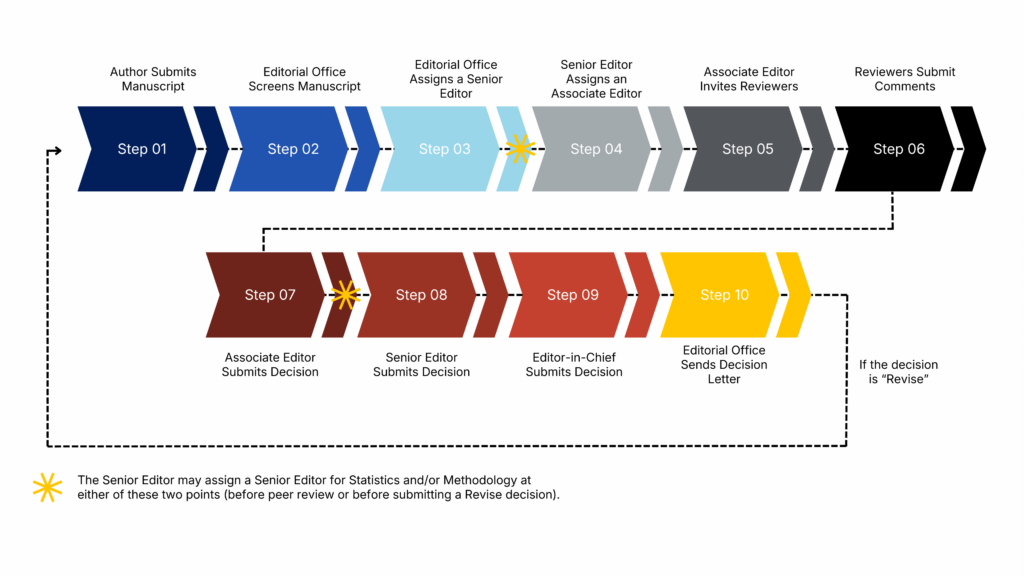
The typical peer review workflow involves a chain of editors that includes the Editor-in-Chief, a Senior Editor, and an Associate Editor. The Editorial Office screens manuscripts to ensure they roughly follow our Instructions for Authors, then assigns a Senior Editor based on manuscript topic. Senior Editors are responsible for triaging assignments to the appropriate Associate Editor, who then will handle the peer review process. After peer review is completed and the Associate Editor has submitted a recommendation, the Senior Editor signs off on the Associate Editor’s recommendation, which is then signed off on by the Editor-in-Chief. As the final step, the Editorial Office proofreads and sends the decision letter to the authors.
The Editorial Office recommends that Senior Editors assign Statistics and Methodology Editors, rather than the Associate Editor. All scientific manuscripts that are likely to be accepted must undergo at least one round of Statistics and/or Methodology review before acceptance. A Senior Editor for Statistics or Methodology should, in most cases, be assigned following the first round of peer review if the feedback is positive and eventual acceptance is likely. In some cases, Statistics or Methodology review can instead be completed prior to Associate Editor assignment and peer review, if the Senior Editor suspects a fatal flaw and would like this verified.
Please refer to the “How-To’s” menu for detailed step-by-step instructions on completing each step of the peer review process in Editorial Manager. Note that parts of the workflow for the EST journal vary due to its storyboard and video format and are not necessarily reflected in the “How-To’s” menu.
*Note that the above workflow reflects the JBJS flagship journal; the workflows for the sister journals vary slightly. For example, only JBJS and OA have Statistics and Methodology Editors and only JBJS has Senior Editors. In the sister journals, much of the responsibilities of the Senior Editors are performed by the Editor for the journal and/or a small selection of Deputy Editors. In some journals with a lighter submission volume, the Editor performs the duties of both Senior and Associate Editors.
What Makes a Manuscript “JBJS Quality”?
JBJS prioritizes work that has clear implications for patient care, surgical decision-making, or healthcare policy. All accepted manuscripts should present original, clinically relevant ideas or data with the potential to meaningfully advance orthopaedic knowledge or practice. Editors should strive to balance articles of broad interest to the orthopaedic community with those focused on more specialized subspecialty topics. The guiding question in this assessment is: Will this article influence practice?
In addition to the above, scientific articles must also be methodologically rigorous, with clearly defined research questions, appropriate study design and statistical analysis, and transparent reporting of limitations. Conclusions should be firmly supported by the data and contextualized within the existing literature.
The target acceptance rate for scientific articles in the flagship journal is approximately 10%. Editors may encounter manuscripts that do not meet this threshold but nonetheless represent valuable contributions to the literature. Such submissions should be considered for referral to a JBJS sister journal, such as JBJS Open Access.
Appeals
Some authors may appeal rejections via email. The editorial staff typically receives those at editorial@jbjs.org. The office staff will upload a copy of the correspondence to the manuscript’s History on Editorial Manager and forward it to the Senior and Associate Editors for a response. Please respond to the staff member; they will handle direct correspondence with the authors.
Helpful Resources
- The website of the Committee on Publication Ethics (COPE) contains several guidelines and flowcharts for ethical issues, including recommendations for ethical editing for new editors.
- The network for Enhancing the QUAlity and Transparency of health Research (EQUATOR Network) provides a library of reporting guidelines and toolkits to enhance and promote the accuracy of health research.
- Copyediting Style Guides can be found here (JBJS in-house) and here (Wolters Kluwer). Any items covered in these guides should not be included in your reviews/decisions.